
- 13 November 2026
- Posted by: Yann Chapron
- Category: Technical corner
Technical corner · Machine safety · 6 min read
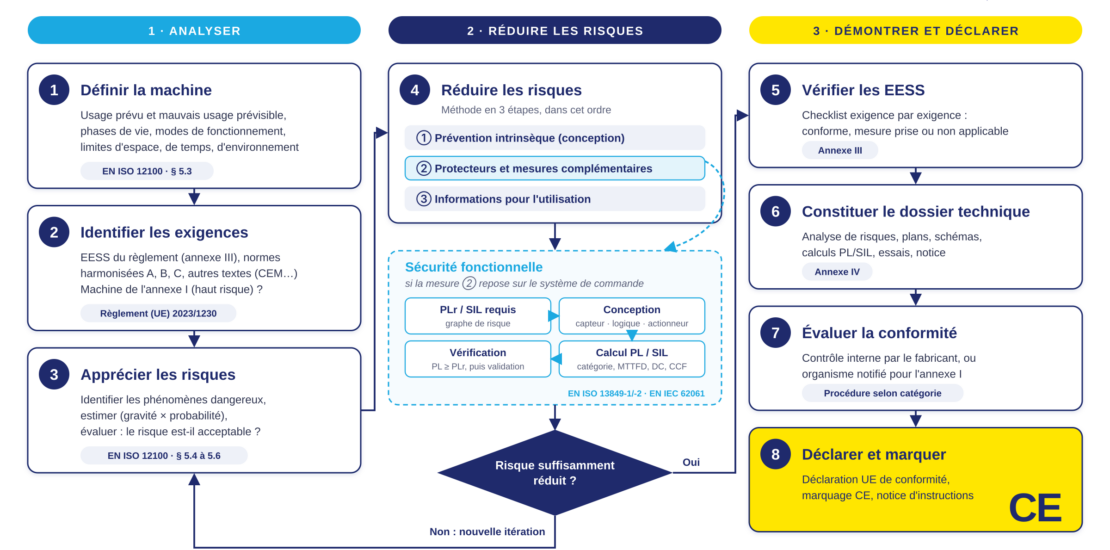
A compliant machine is not a CE sticker applied on delivery. It is the result of a process: analyse the machine, reduce the risks, then demonstrate it in a file that stands up in the event of an accident or an inspection. Here is the 8-step method ITS follows, and the situations where it applies.
Which machines?
- A new machine, from design to delivery. The process starts at the design stage and ends with the EU declaration of conformity and CE marking, before commissioning. This also applies to a machine built for your own use: you are then its manufacturer.
- An existing machine. Taking stock of a machine in service: an up-to-date risk assessment, requirements checked one by one, and a file rebuilt if it is incomplete. It is the essential basis before any change, and a protection in case of inspection.
- A modified machine, from 20 January 2027. Under Regulation (EU) 2023/1230, a user who makes a substantial modification becomes the manufacturer of the modified machine, and must then follow the same complete process. To find out whether your project is concerned, read our article Machinery Regulation 2023/1230: modifying an existing machine without unintentionally becoming its manufacturer.
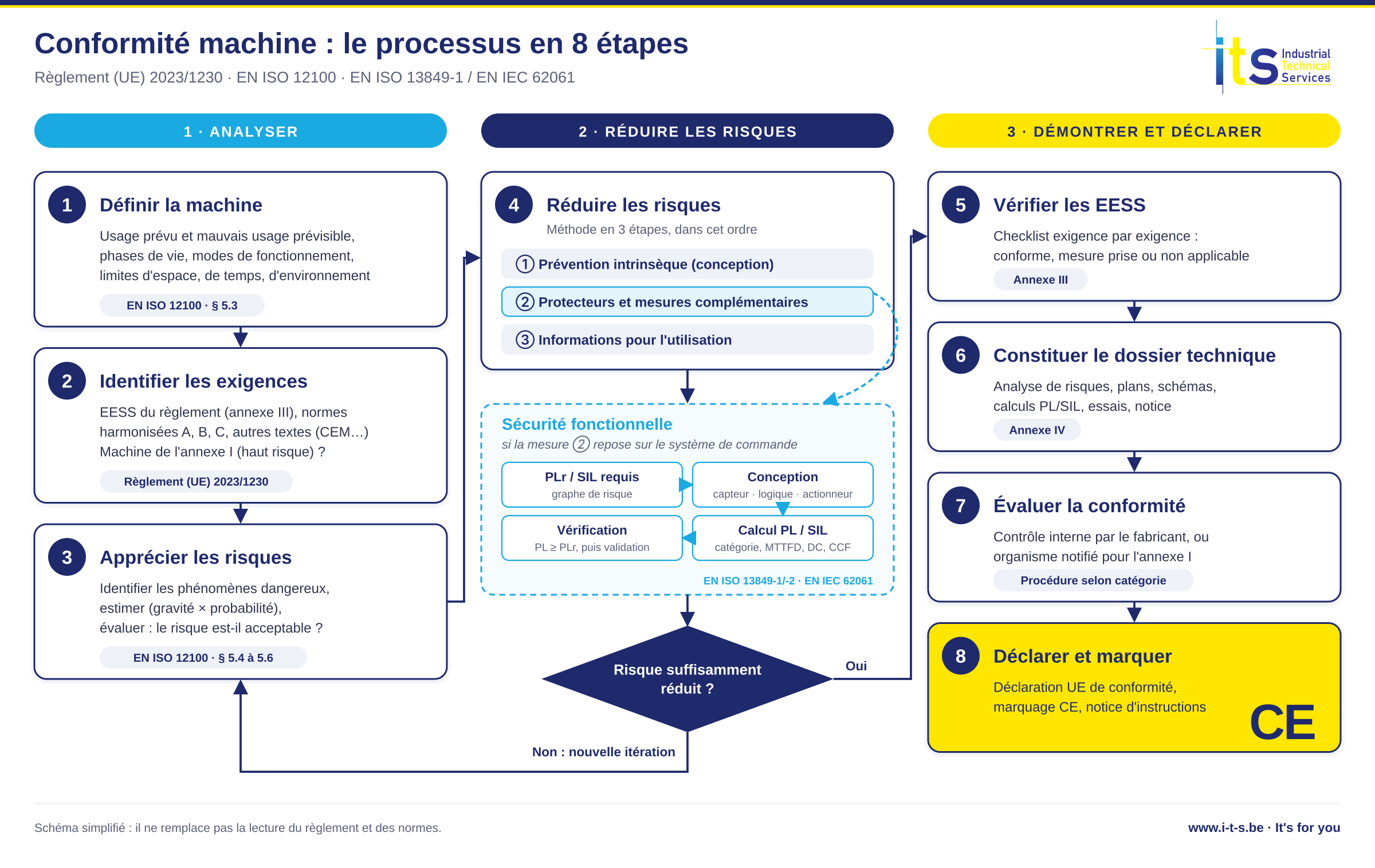
The 8 steps in brief
Analyse (steps 1 to 3). First, define the machine: intended use, reasonably foreseeable misuse, life-cycle phases (transport, installation, production, setting, cleaning, maintenance…), limits. Next, identify the applicable requirements: Machinery Regulation, harmonised standards, other legislation (EMC, low voltage…), and check whether the machine belongs to the high-risk categories. Finally, assess the risks: each hazard is identified and estimated, phase by phase.
Reduce the risks (step 4). Always in the same order: first eliminate the hazard by design, then add guards and protective devices, and only last inform the user. When a protective measure relies on the control system (light curtain, door switch, emergency stop…), its required performance level is determined and then verified. As long as the risk is not sufficiently reduced, the loop starts again.
Demonstrate and declare (steps 5 to 8). Each essential health and safety requirement is checked: compliant, measure taken, or not applicable with a justification. The technical file is compiled (risk assessment, drawings, diagrams, calculations, tests, instructions). The conformity assessment procedure is chosen: internal production control by the manufacturer in most cases, a notified body for certain high-risk machinery. Finally come the EU declaration of conformity, the CE marking and the instructions.
A tool so nothing is forgotten: the compliance file
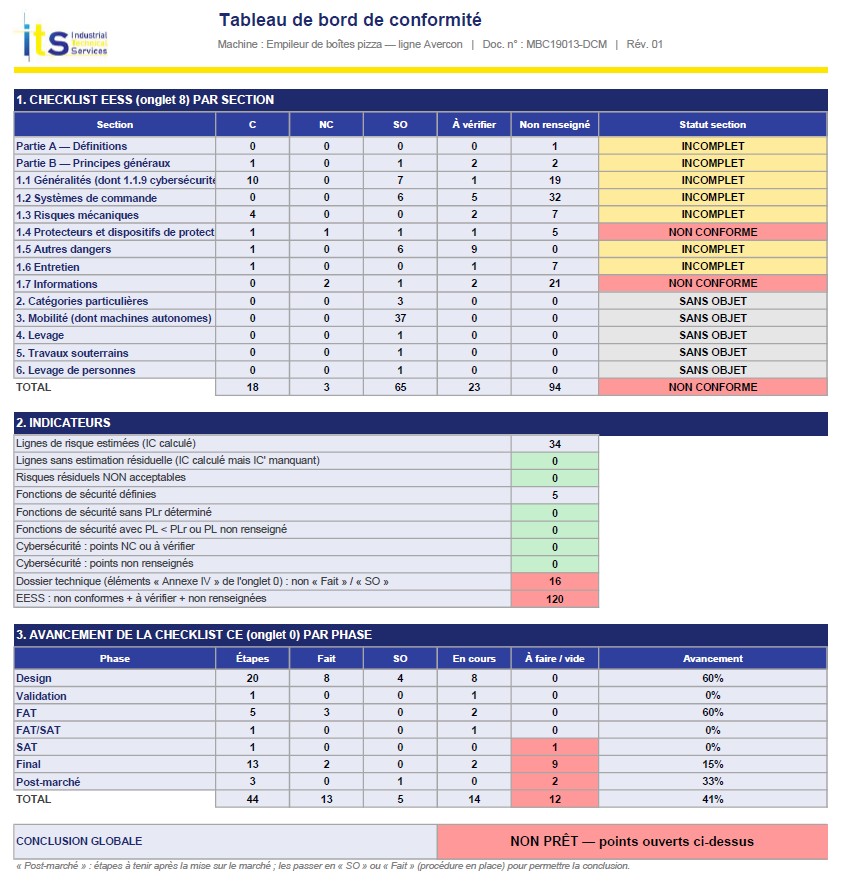
To follow this process without missing anything, ITS uses a structured compliance file, organised in the order of the work:
- Classification: machine status, applicable legislation, substantial modification or not, high-risk category;
- Scope and method: uses, limits, life-cycle phases, risk estimation scale and acceptability criterion;
- Risk assessment: initial risk, measures, residual risk, for each life-cycle phase;
- Safety functions: required and achieved performance level, validation;
- Cybersecurity: the new requirement for protection against corruption;
- Essential requirements and CE checklist: status of each requirement and progress by phase (design, factory tests, commissioning, close-out);
- EU declaration of conformity, pre-filled from the file.
A dashboard brings everything together and gives a clear conclusion: the file is “ready” or “not ready”, with the list of open points.
The most common mistakes
- Doing the risk assessment at the end of the project, when the design can no longer change: it must guide the design, not justify it afterwards.
- Thinking CE-marked components are enough. A machine assembled from compliant components is not compliant as such: it is the whole machine that is assessed.
- Ticking “not applicable” without justification: every requirement set aside must be explained.
- Forgetting cybersecurity, now required for remote access and safety software.
- Letting the file go out of date: every change to the machine must be recorded and assessed.
How ITS supports you
ITS prepares or completes the compliance file for your machines, new or existing: risk assessment, safety functions, requirements check, technical file and EU declaration. We also step in ahead of a modification project, to determine whether it is substantial and avoid unpleasant surprises at the end of the job.
A machine to bring into compliance, or a modification project? Let’s talk.
This article describes a general approach and does not replace reading the Regulation and the standards, or an assessment of your machine.

